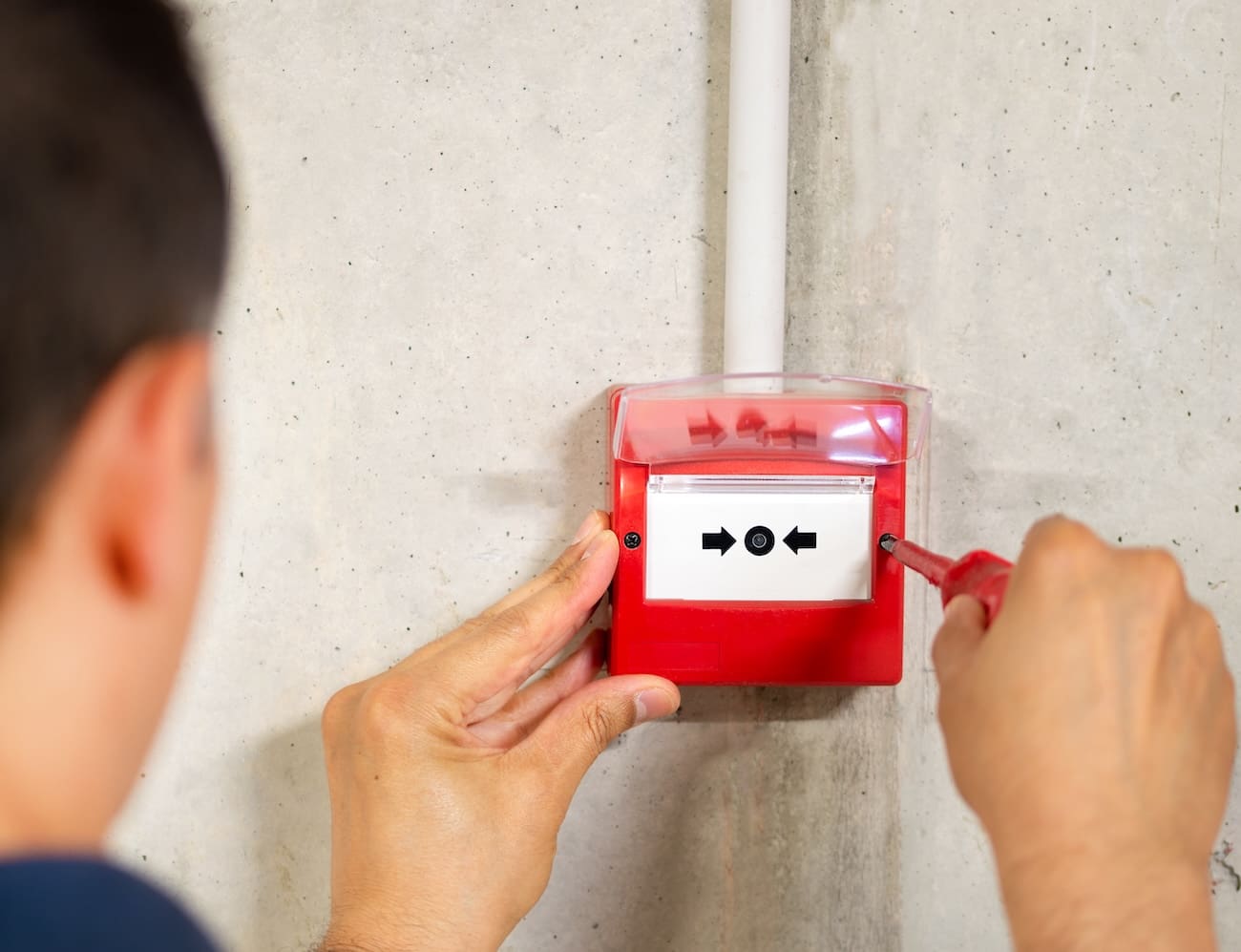
Fire is one of the most significant risks to any business, and early detection is vital for protecting life, property and continuity of operations. Current legislation requires all building owners to assess fire risk and put appropriate measures in place, whether for a small premises or a multi-storey commercial site.
Lifeline is the only Isle of Wight company with BAFE SP203 Third Party Approval for the design, installation and maintenance of fire alarm and smoke detection systems. Our work is independently audited, giving you confidence that your system meets the latest British and European Standards and has been designed with safety and compliance at its core.
At Lifeline, we do not just maintain the systems that we install, we can take over your existing Fire, Security or CCTV system, and deliver you the service and support you have been missing.
If you are unhappy with the service, performance or responsiveness of your current supplier, our local experienced team will arrange to seamlessly adopt your existing system and get it performing to its optimum ability.
With decades of hands‑on knowledge across both modern smart technologies and older legacy equipment, we understand how to keep every system operating at its best. Let us step in and give you the confidence that your system is reliable, and working as smart as we do.
Most businesses affected by a serious fire do not recover within a year, so a compliant, well-maintained fire alarm system is essential. All Lifeline systems are designed and installed to BS5839:2017 Part 1, with our work independently audited to confirm full compliance. We keep a complete design trail and issue formal certification for your records.
Our specialists support you through system design following your Fire Risk Assessment, and we provide scheduled preventative maintenance to keep your system operating reliably. Lifeline manages all inspections in line with the latest British Standards, ensuring your safety, security and compliance remain our priority.
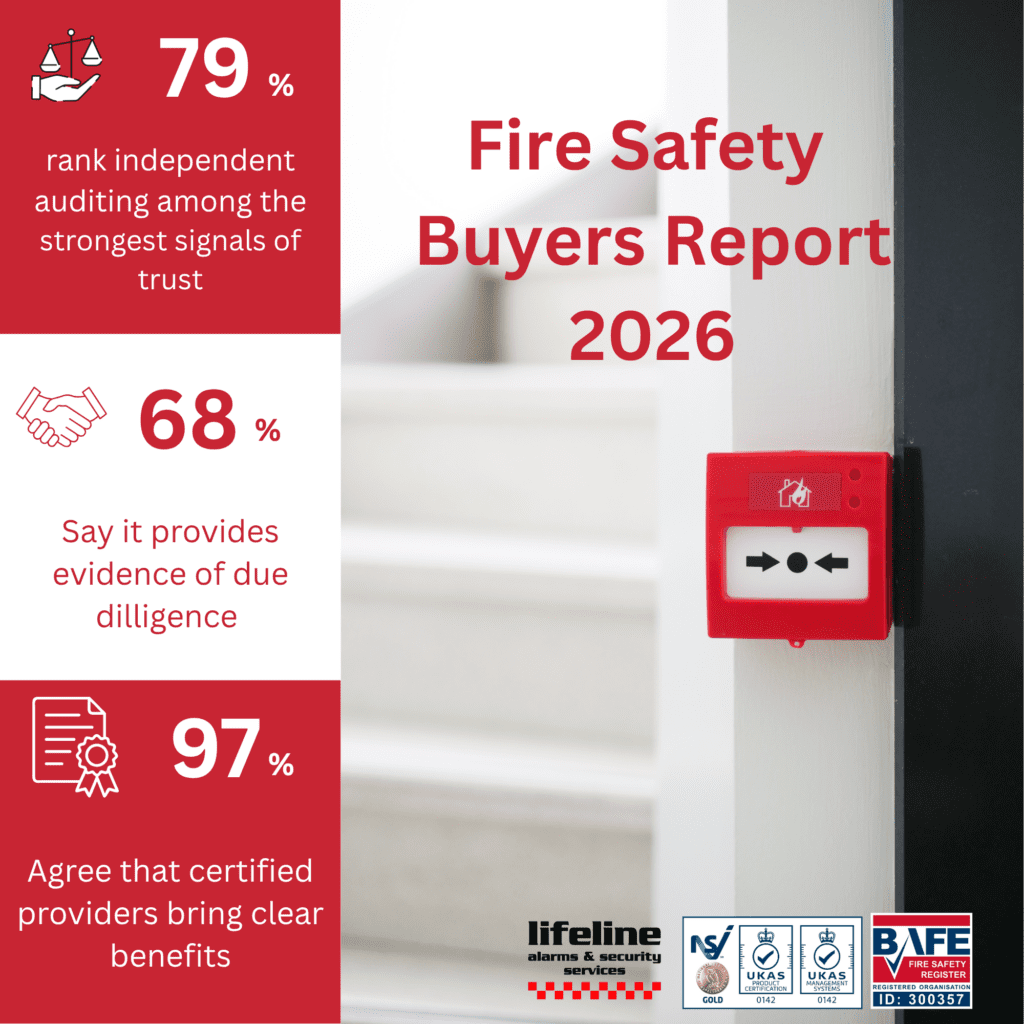
The latest Fire Safety Report 2026, published by NSI and BAFE, highlights a significant shift in customer behaviour. Independent certification has now emerged as the single most important driver of trust when selecting a fire safety partner.
Today’s buyers and specifiers are no longer relying solely on reputation or recommendations, they are demanding clear, verifiable proof of competence.
Lifeline is proud to meet and exceed these evolving expectations. The company holds BAFE SP203 accreditation for fire alarm systems, a recognised benchmark for quality and competence in the sector. Notably, Lifeline was one of the first 50 companies in the UK to achieve this prestigious certification, demonstrating an early and ongoing commitment to industry leading standards, well before certification became the industry’s primary trust marker.
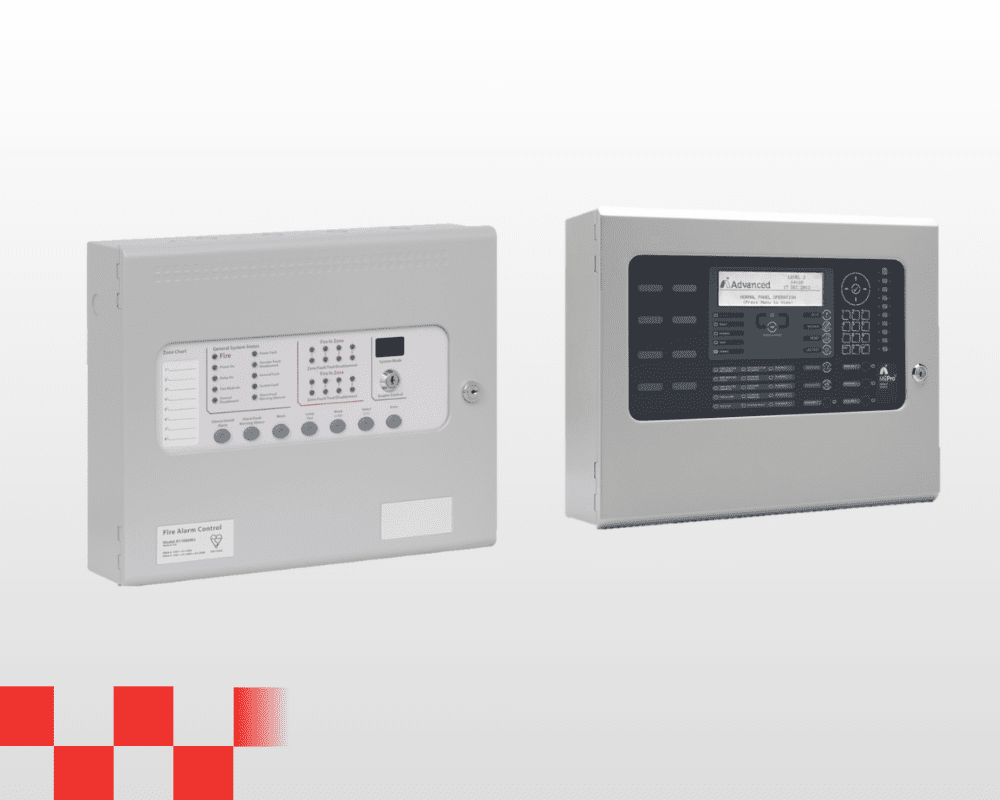
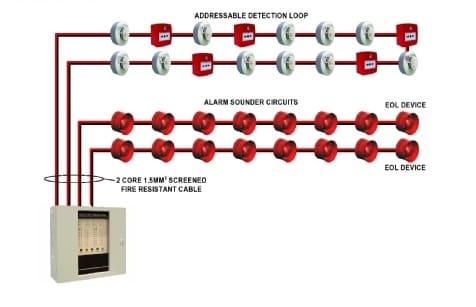
Wired or cabled Fire Alarm Systems are the most popular and traditional form of installation. They tend to be less expensive to install and maintain and require little in the form of battery replacements other than Fire Alarm Panels and Power Supplies, which should be included in and service inspections.
Lifeline partner with industry leading manufactures Kentec and Advanced Fire. These two manufacturers provide an open protocol format, meaning customers are not locked into any one particular supplier or provider.
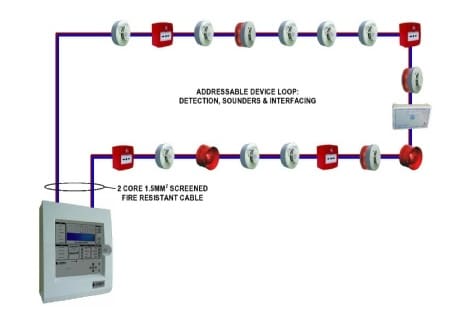
Installing a fire alarm system can be intrusive, particularly in heritage or listed buildings. Lifeline provides a practical alternative using modern wireless technology.
In partnership with Electro Detectors, we supply wire-free systems ideal for hotels, manor houses, historic sites and other sensitive properties. These systems comply with BS 5839 Part 1 and can be deployed as temporary or permanent solutions.
Wireless systems are typically addressable, with each device carrying its own ID and reporting the exact location of any fire, offering precision without the disruption of cabling.
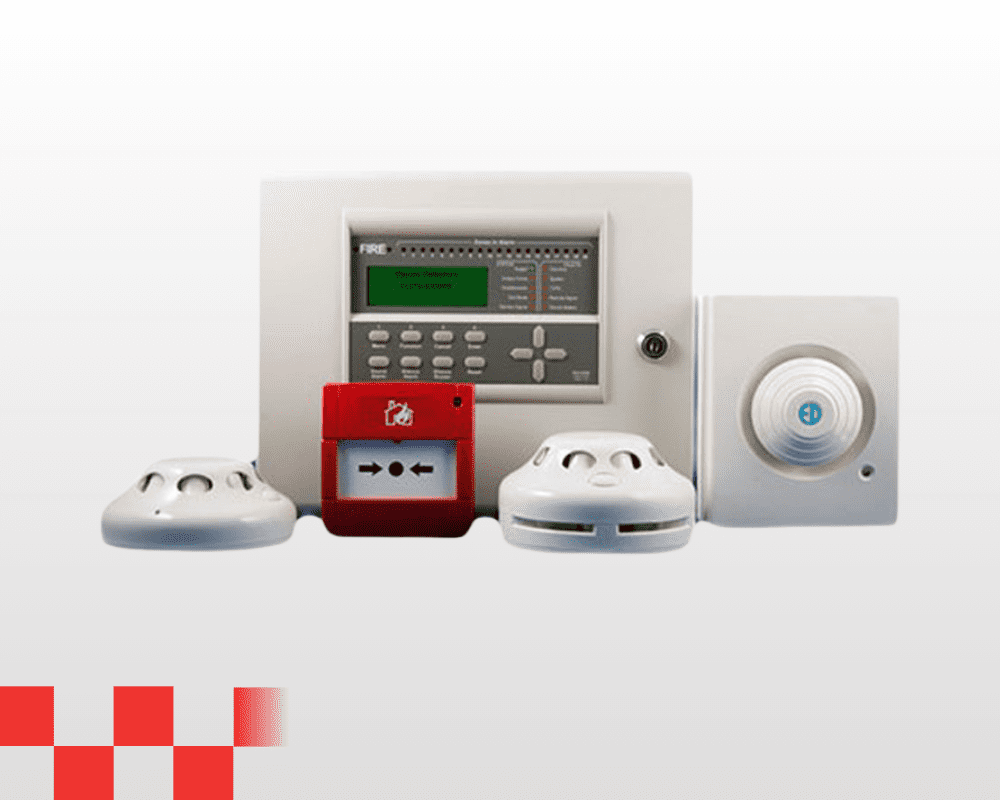
Your safety, security and compliance are our priority. Lifeline provides scheduled preventative service and maintenance visits, handling all arrangements so the process is straightforward and stress-free. All inspections are carried out to the latest British Standards to keep your system performing reliably.
Our service engineers operate to national standards across the Isle of Wight and are fully trained in both preventative and corrective maintenance. Every team member is security screened to BS7858 and holds an Enhanced Police Disclosure and Barring Check, giving you confidence in the people supporting your system.

Contact us on 01983 521621 or info@lifeline-security.co.uk to arrange a free site survey. Once you’ve reviewed the proposal and returned the agreement, we’ll book your installation.
Our qualified engineers will install, programme and commission the system. From then on, you can operate with confidence knowing your premises is protected by Lifeline.
CCTV Isle of Wight
These types of systems are purely for the protection of property and fall into two classifications, P1 and P2. The objective of a category P is to provide the earliest warning of a fire to minimise the time taken from ignition of a fire to detection and the subsequent attendance by the fire services, minimising loss to the property.
Category P1
This type of system is designed to protect the entire building, and thus requires AFD throughout the premises. While not dependent on a thorough fire risk assessment (FRA), a FRA is helpful for designing P1 systems, as appropriate detectors will need to be installed in each room to cover the specific risks present. However, as it is focused on the protection of property, alarm devices (sounders, beacons, bells, voice alarms, etc) are only required where specified – in an on-site security office, for example.
Category P2
Category P2 requires AFDs in high risk areas, only. Category P2 systems are commonly used when combining with a life protection system other than Category M. For example, a building may have Category L3 protection for escape routes and adjoining rooms, with an additional AFD in the server room that is not directly connected to an escape route.
Life protection systems can be divided into various categories, L1, L2, L3, L4, L5
Category L1
L1 systems are the “ultimate” in life protection as they recommend both manual call points (MCPs) and automatic fire detection (AFD) be installed throughout the entire premises. For the AFD installed in addition to L2 requirements care should be taken to choose the detector types according to not only the fire risks in each room, but also the persons at risk. For example, heat detectors should not be the primary detector type in bedrooms as they will not provide quick enough warning to protect the occupant’s life.
Category L2
While the fire risks in rooms opening onto escape routes should be taken into consideration for L3 systems, this can often be done by common sense or in discussion with the client. L2 systems, however, require that a thorough Fire Risk Assessment (FRA) be carried out by a competent person to identify areas of high fire risk. Appropriate AFD should then be used in the identified locations in addition to the requirements of L3.
Category L3
In addition to MCPs throughout and optical AFD in escape routes, Category L3 stipulates AFD be installed in all rooms, corridors and compartments that open onto escape routes. These rooms may use any of the common detector types, unlike escape routes, so appropriate detectors should be chosen based on the purpose and fire risks within them. However, the standard does recommend that certain specialist detectors such as flame or video should only be used in these rooms in addition to common detectors.
Category L4
Building on Category M, L4 has MCPs throughout the building for occupants to manually identify a fire while automatic fire detection (AFD) should be installed along escape routes including stairwells. AFDs used for Category L4 systems should be smoke detectors – specifically, optical point detectors or aspirating smoke detectors (ASD) that rely on optical smoke sensors.
Category L5
Similar to L2, this Category can only be designed and installed based on the findings of a thorough FRA – except that L5 should not actually be attempted by designers or installers unless specified in the FRA. Category L5 is for meeting specialist fire safety objectives, often in variation to the recommendations where strict adherence would not be possible. Such systems could include automatically closing metal shutters on a shopfront to contain the fire away from a shared concourse, or adding optical point detectors to bedrooms not adjoining the escape route in addition to an L4 system. L5 systems should be designed in conjunction with, and agreed by, relevant authorities before they can be signed off for installation.
A BS5839 Category M Fire Alarm System is a manual operation only system which has call points on all exits as well as corridors where persons are not expected to walk any more than 45m to operate one. All categories of life protection will have a type M system installed.