
against which your Fire or Security System will be installed to and perform.
Signalling
Your attention is drawn to the fact that failure or compromise of single path signalling cannot be passed to the police. While the failure persists, subsequent alarms cannot be signalled to the Alarm Receiving Centre and passed to the police. Off site transmission of Alarm Signals will be to EMCS Monitoring Services Ltd.
If a PSTN telephone line is the sole method of communication, to comply with standards the system will make a daily national rate call to the ARC to check the integrity of the line. The client will be responsible for the cost of these calls. It is strongly recommended that you check with your insurance company that a single path transmission is acceptable. Please note, standard PSTN telephone lines are being phased out and will become mostly extinct by 2025. For more information please contact us.
Apps and Smart Devices
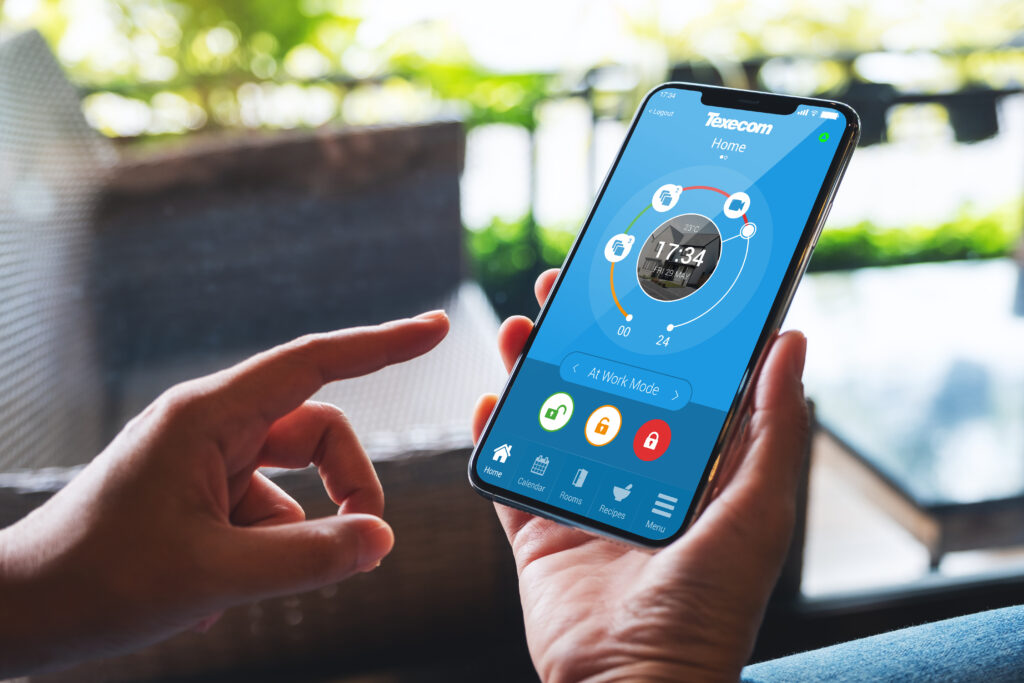
If using a device (such as a smart device App) to remotely set/unset your intruder alarm system, your attention is drawn to the fact that whenever a premises’ is unattended but its intruder alarm system(s) is (are) not fully set, any related insurance cover might be inoperative. For advice on this matter, it is recommended that you consult your insurer(s).
IMPORTANT: The use of Apps is considered to be a convenience and should not be relied upon for primary signalling. Factors such as loss of internet or cloud connection, power failure to the router, internal WIFI coverage and other external or environmental issues may affect the performance of the system. Lifeline cannot be held responsible for these failures. This does not apply to the primary signalling system which is separately powered and backed up as part of the system.
Used responsibly, smart remote devices can be a valuable asset. We bring to your attention however, that it is possible, that low battery at the remote or smart device and/or poor or intermittent communications and network coverage could lead to situations where you may have initiated setting or un-setting and are unable to verify, at least for a period of time, whether the action was successful or not. We strongly advise against using such remote/smart devices at times when the battery is low or where there may be signal strength issues.
Internet & WiFi Routers
The system will be configured to connect with the router provided at the time of installation. The router is the property of the client. Lifeline take no responsibility for the performance of the Internet Service Provider or their equipment.
IMPORTANT: If the router is changed without our knowledge, this will prevent further use of the App, Remote Service and Diagnostic Services. New or replacement routers need to be configured to the Intruder Alarm System by an alarm engineer which will be chargeable.
Engineering
Please be advised by accepting these works you also give Lifeline permission to use an engineer code or remote engineer access to the programming functions. With monitored systems Lifeline has remote access to the security system via PC to undertake remote servicing and undertake diagnostics. This does not affect the performance of your security system. All detection devices LED’s are left in an on condition by default to permit the user to walk test the system unless specifically requested.

Service Agreements, maintenance & remote servicing
Please note that Service, Maintenance & Monitoring Agreements do not include spare or replacements items. Wireless systems will require battery changes in devices normally between 2 – 3 year cycles depending on environment.
Where practical, remotely supported systems will receive virtual service inspections by our support systems, with a minimum of one physical inspection by an attending engineer as detailed in BS9263:2016. By accepting a service agreement, you provide Lifeline with approval to carry out remote service and support functions and features. Read more details here.
Positioning & Locations
Locations are described as front left or rear right are from the perspective of the surveyor looking in to the property from the front elevation. Locations specified are best locations in the surveyors’ opinion. Actual installation may vary slightly depending on logistical practicality.
Wireless Systems
Where systems are described as ‘wireless’, this refers to the bulk of the installation comprising of the detection devices. Parts of the system may still need to be cabled, this might include although not limited to, External Sounder, the Keypad and Control Panel and connection to any communication devices.
Note:
It is not possible to determine at the time of the site survey the nature and structure of the building, the hidden pipe work and cabling, the exact final location of equipment and the allotment of zones may be amended by the installing engineer in agreement with the customer at the time of install. All equipment will meet a minimum of environmental class II unless otherwise stated in this specification.
Mains power supply (Customer responsibility)
A suitably rated (3 amp) un-switched fused spur or a socket outlet (which will protected against inadvertent removal or switch off) should be provided as power for the system. This can be provided by ourselves, if a safe and suitable ring main exits near to the Panel location, or can be provided by your approved electrician. If the latter, then this should be prior to the commencement of the installation and should be sited to allow the installing engineer room to position the control unit.
Legals, Policies, Standards and Documents
Grading of Intruder and Hold up Alarm Systems
In accordance with the European Standard Technical Specification DD CLC/TS 50131-7:2010, a site survey and risk assessment of your property has been carried out. The risk assessment relates solely to the grading and design of the proposed intruder alarm and is based upon information available at the time of survey. All equipment fitted will conform to EN 50131 – Grade 2 or higher. See Grading Table.
ALARM GRADE | LEVEL OF RISK | TYPICAL PREMISES | INSURANCE APPROVED | NOTIFICATION | ALARM CENTRE MONITORED | POLICE RESPONSE AVAILABLE |
1 | Very Low | DIY Type Installation
| No | Audible On Site Only* | No | No |
2E | Low to Medium | Domestic & Low Risk Commercial
| Yes | Audible On Site Only* | No | No |
2 | Low to Medium | Domestic & Low Risk Commercial
| Yes | Audible Site & Monitored Off Site** | Yes Single Path | Yes |
3 | Medium to High | High-Risk Residential & Commercial
| Yes | Audible on Site & Monitored Off Site# | Yes Dual Path | Yes |
4 | Very High | Banks, Government Buildings, MoD
| Yes | Audible on Site & Monitored Off Site# | Yes Dual Path | Yes |
*Including supplementary notifications such as Text Message, Auto Dialer and Smart Device App
**Catastrophic Failure Polling Time Maximum 25 hours
#Catastrophic Polling Times for GPRS Range between 3 minutes & 31 Minutes according to Signaling Grade
Information on & Alarm Confirmation Statement as required by BS 8243
In order to reduce false alarms and to ensure there is a high probability of a genuine activation, under the current police (NPCC) policy, the police will only respond to confirmed alarms.
Sequential confirmation, as specified by Lifeline Alarm Systems Ltd, requires that two separate detectors on independent circuits activate, within a pre-defined time window, before a confirmed alarm condition can be notified. Therefore, the system has been designed with the intention that an intruder will probably activate at least two detectors before reaching any desirable stock or valuables.
If a single detector activates the alarm, this will be transmitted to an Alarm Receiving Centre (ARC) who will inform the keyholders, but it will not pass the alarm to the police. If a second activation occurs on a different detector within the specified confirmation time, the system will send a confirmed alarm signal to the ARC, who will then contact the police.
At the end of the confirmation time, if a second activation has not occurred, the system will reinstate and the specified confirmation time window will start again. At the time of reinstatement if a detector is still active, the system will inhibit that detector and a signal will be passed to the ARC who will inform the keyholders.
Note: – Once a confirmed alarm has been passed to the ARC the system must be restored by the alarm company operative and not by the keyholder.
Important! A requirement of BS 8473
Due to the previous high incidence of customer error and accidental activation upon entry, your attention is drawn to the fact that if an intruder succeeds in forcing open the initial entry door, a confirmed alarm cannot be generated until the entry time has expired.
System users
The system offers multiple different users on different levels of access, these are –
Staff codes (Digital Key) – (equal to EN 50131-1 user access level 2) Each Digital Key is programmed to allow the staff to set, unset, part set and reset after non-policed activations.
Manager codes (Digital Key) – (equal to EN 50131-1 user access level 2) Each Digital Key is programmed to allow the alarm manager to set, unset and reset same as the staff, but will also allow various other limited programming functions.
Engineer codes – (equal to EN 50131-1 user access level 3) These codes allow the alarm servicing company to set the system parameters and functions and to carry out servicing and engineering work without creating an alarm.
Please note – the level 3 engineer access codes cannot be used without prior authorisation by a user or manager Digital Key or, level 3 access codes may be used without prior authorisation if the I&HAS is unset and the user to be given access at level 3 is at the supervised premises and accesses the CIE locally. When this option is used notification will be given by a warning device and remotely, i.e. by the ATS, when access is granted.
Inhibiting/Isolating detectors
The control panel has the facility to allow selected users to inhibit/isolate individual detectors or zones to allow for temporary work to be carried out or following accidental or storm damage to the building or any other suitable reasons. The benefit is that the rest of the system can still be used even if one or more detection device is out of action.
Note – It must be remembered that there will be no active alarm and no police response in areas where a detector has been omitted. Therefore, there may not be any insurance cover on that area. Please check that this is acceptable to your insurer.
The ability to enable detectors or zones to be inhibited lies with the alarm company and is decided by agreement between the alarm company and the customer.
Intervention (Planned responses to alarm activations)
The table below details the planned responses to the alarm activations and other possible notifications by the Alarm Receiving Centre. These have been proposed for your intruder alarm system. The table prescribes what the response will occur for each activation in both the unset condition and the set condition.
Activation | Condition Unset | Condition Set
|
Fire | The Fire and rescue service will be contacted. Their response is dependent upon the Alarm Receiving Centre filtering procedure and the local fire service attendance policy for your type of building/use and its previous alarm history. | The Fire and rescue service will be contacted. Their response is dependent upon the Alarm Receiving Centre filtering procedure and the local fire service attendance policy for your type of building/use and previous alarm history.
|
Activation | Condition Unset | Condition Set
|
Personal Attack (Hold up) If Fitted | The Police will be contacted | The police will be contacted |
Intruder | Not permitted | The nominated key holder(s) will be contacted.
|
Open (unset) and close(set) or miss-operation | When you unset the system a signal will be sent and logged at the Alarm Receiving Centre. | When you set the system a signal will be sent and logged at the Alarm Receiving Centre. |
Circuit Inhibit/Reinstatement | Not permitted | If a detector has been activated and another detector has not activated within the confirmation time then the system will be re-instated but the detector will be inhibited. The Key holder will be contacted to be informed.
|
General Fault | If the alarm system has a fault then the ARC will contact the key holder dependent upon client request
| If the alarm system has a fault then the ARC will contact the key holder |
Confirmed alarm | Not permitted | The Alarm Receiving Centre will following a filtering delay of up to 120 seconds contact the police.
|
Tamper | The Alarm Receiving Centre will contact the key holder | The Alarm Receiving Centre will contact the key holder. If this follows an intruder signal or precedes an intruder signal then it will contribute to a confirmed alarm.
|
Transmission Line Fault | The Alarm Receiving Centre will contact the key holder | The Alarm Receiving Centre will contact the key holder. If this follows an intruder signal or precedes an intruder signal then it will contribute to a confirmed alarm.
|
Mains Fail | The Alarm Receiving Centre may contact the key holder dependent upon request of the client | The Alarm Receiving Centre will contact the key holder immediately or following a defined delay dependent upon client request |
The system and maintenance procedures described in this proposal is as noted above. You are strongly advised to ensure that the Grade proposed will meet the requirements of your insurer. All components used in this system have been certified by the manufacturers as suitable for use in the proposed grade. Certificates are held on file at Lifeline Alarm Systems Ltd, Newport, Isle of Wight.
Warranty:
The entire system is warrantied for a period 12 months from the date of installation for normal use against product failure, defects and faulty workmanship. In the event that a manufacture offers an extended warranty on any component then this will be honoured provided that this was supplied as part of the original system installation or added to and supplied and installed by ourselves. Warranty does not include damage to cable infra structures. Interference to the system or works to the system by any other third party (including the user) will invalidate all warranties. Warranty claims are handled on an individual basis.
Policies & Documents
NPCC | National Police Chiefs Council Policy for Intruder Alarm Systems. |
NCP120-1 | NSI Code of Practice for the Planning, Installation Commissioning and Maintenance of Intruder Alarms |
BS 7671 | Requirements for Electrical Installations |
EN50131 | European Standard for Intruder Alarm Systems |
PD6662 | UK implementation of EN50131-1 2017 to permit amongst other things UK Police Response |
BS 8243 | Industry standard and requirements for setting and un setting, and methods of signalling to ARC to invoke police response. – Code of Practice |
BS 9263:2016 | Commissioning, maintenance and remote support – Code of Practice |
BS 8473:2018 | Intruder Alarms & Hold Up Systems, Management of False Alarms – Code of Practice |
Definitions
FINAL EXIT | Zones of this type must be the last detector to be activated on exit, or the first to be activated on entry. This type of zone may be used to finally set the system or to start the entry procedure. |
ENTRY/EXIT | This type of zone is used for detectors placed between a Final exit zone and a keypad. If an Entry/exit detector is violated when the system is set an alarm condition occurs. If the entry/exit timer is running when an Exit detector is violated no alarm occurs. |
INTRUDER/ NORMAL ALARM | A zone of this type will cause an alarm condition to be signalled when it is activated during a set condition. |
PERSONAL ATTACK | A zone that is used for deliberately operated devices to signal an alert in the event of an anticipated assault. |
24 HOUR | A zone which will cause an internal alarm when the system is unset and a full alarm when the system is set. Providing the installer has programmed “Zone Omit Allow” the user can omit 24 hour zones. |
FIRE | Smoke and heat detectors connected to this type of zone will cause a distinctive alarm to sound. They will operate 24 hours and always trigger the communicator if fitted. |
ARC | Alarm Receiving Centre |
NPCC | National Police Chiefs Council |
NSI | National Security Inspectorate |